Handwriting
Handwriting
Handwriting is a basic skill that influences the quality of work throughout the curriculum. By the end of their Primary School Journey, all pupils at Teversham should have the ability to produce fluent, legible and, eventually, speedy joined-up handwriting as outlined in the National Curriculum. In line with findings from the Writing Framework, our intention is to make handwriting an automatic process which frees up cognitive space to allow for development of language composition skills; by supporting learning in both transcription and composition, we give our children the best chance to become proficient writers.
Teaching Progression and Expected Outcomes
Pre-School
Teaching of handwriting begins in our pre-school where activities are provided which enable children to develop their fine- and gross- motor skills.
Reception
Teaching of handwriting happens daily in Reception following the Little Wandle Handwriting programme. At the end of Reception, children are expected to have formed a correct pencil grip and have learnt to form each letter in the alphabet with correct starting and ending points and in the correct direction. Whilst handwriting lessons take place daily, children are also subjected to an environment which provides plentiful opportunities to continue developing core strength and both fine- and gross- motor control.
Year 1
Teaching of handwriting continues to happen regularly in Year 1 following the Little Wandle programme principles. Letter Families are taught and children continue to practise their pencil grip and formation of letters (including the digits 0-9 and capital forms of letters). Finger-spacing is also developed as the children’s fine motor control improves.
Year 2
In Year 2, children may begin to learn joined handwriting style in small groups when they are ready. They will learn to form lower-case letters of the correct size relative to one another. They will write capital letters and digits of the correct size, orientation and relationship to one another and to lower-case letters. They will also continue to use spacing between words that reflects the size of the letters.
Year 3 and Year 4
In Years 3 and 4, children will increase the legibility, consistency and quality of their handwriting style; they will learn the appropriate diagonal and horizontal strokes that are needed to join letters and understand which letters, when adjacent to one another, are best left un-joined. Children may earn a Pen Licence from this point.
Year 5 and Year 6
In Years 5 and 6, children should be writing legibly, fluently and with increasing speed. More autonomy is expected and decisions will be made such as choosing which shape of a letter to use when given choices and deciding whether or not to join specific letters. Children will be encouraged to choose the writing implement that is best suited for a task.
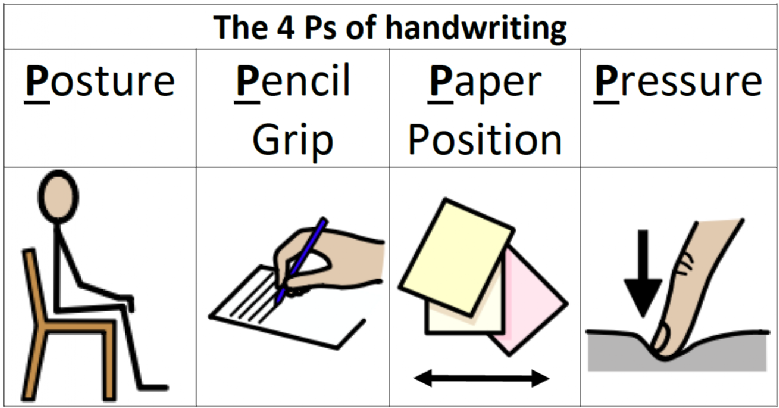
The 4Ps
We use this visual in every classroom at Teversham to help our pupils understand the importance of being physically ready every time we pick up our pencil or pen. It helps us to take pride in every piece of work we produce. As part of this process, we teach children who are left-handed how to adapt their paper position to support their handwriting journey too.